FEDERATION
🌐
Broker Federation & Peer Links
Inter-broker forwarding over the mmq-peer/1 protocol connecting Go Edge nodes and JVM clusters. Features zero-loss monotonic sequence replay, dynamic subscription interest routing, and active/standby high availability.
EDGE VISION
📹
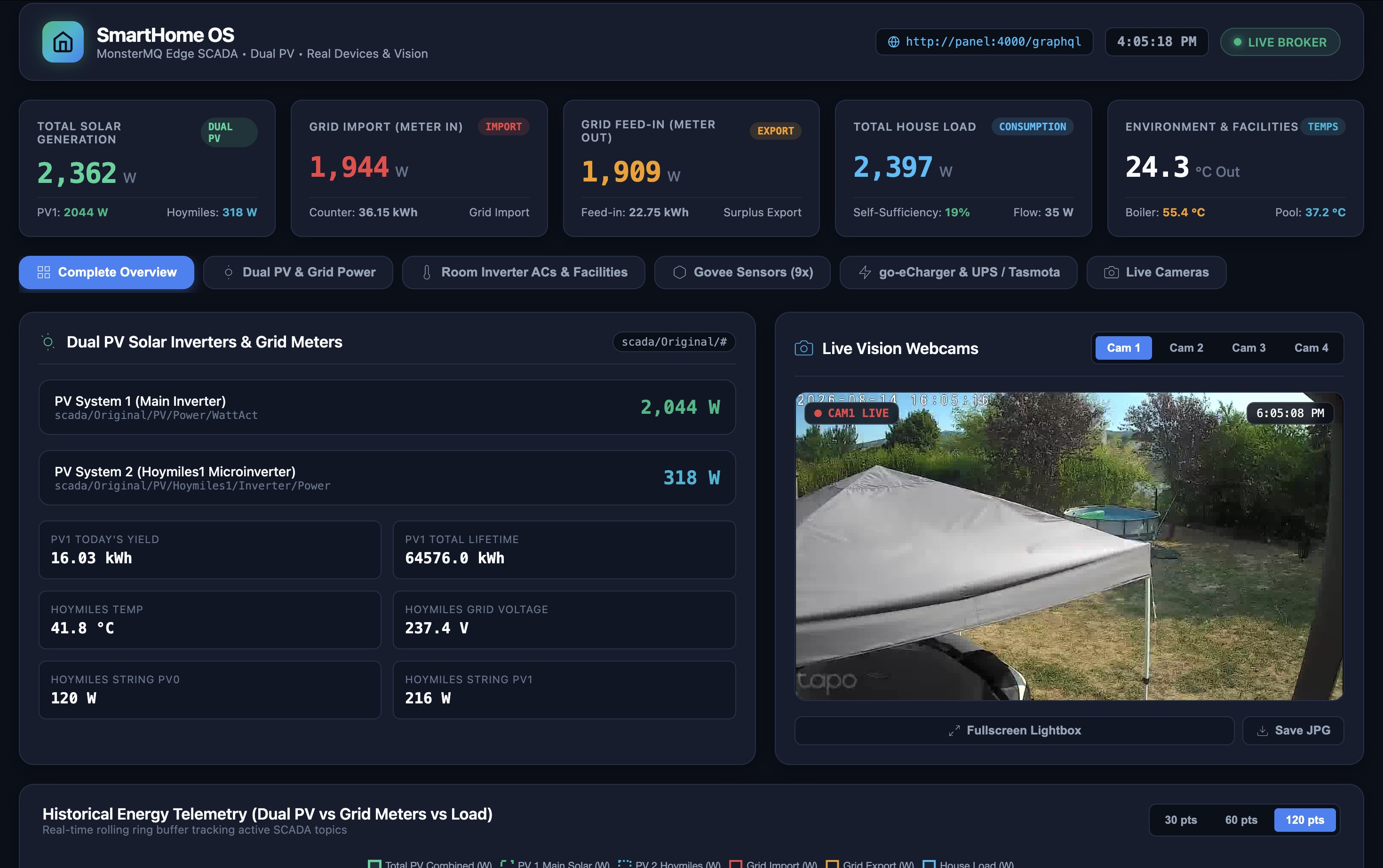
RTSP Camera Bridge & Pure Go H.264
Zero CGO RTSP camera bridge for MonsterMQ Edge. Built-in pure Go H.264 & MJPEG decoder with ARM64/ARMv7 support, round-robin slot topics, MQTT snapshot triggers, and live WebSocket streaming.
SCRIPTING
🐍
Python, Starlark & JS Scripting
Execute real-time event scripts directly inside the broker. Run Starlark (pure Go Python dialect) on Edge with zero CGO, or Python (GraalPy) and JavaScript (GraalJS) on MonsterMQ Core on incoming message hooks.
🔄
Over-the-Air (OTA) HMI Sync
Synchronize and push HMI web application bundles directly across central brokers and remote edge panels over MQTT topics. Zero SSH, zero extra web servers, and instant browser hydration.
⚡
Raw Binary REST & WebSocket Streams
High-throughput HTTP REST endpoints for raw binary payload retrieval and wildcard topic reads, accompanied by low-latency WebSocket live streaming for images, sensors, and telemetry.
WEB APPS
💻
Embedded Web Apps
Deploy and host custom web applications, operator HMIs, and diagnostic dashboards directly from MonsterMQ. Instant WebSocket/SSE data streaming combined with Last Value Store state hydration.
CLI TOOLS
⌨️
MonsterMQ CLI & Tools
High-productivity command-line tooling for developers and automation engineers. Live trace topic streams with colorized payloads, query factory state snapshots, and automate CI/CD pipelines via vogler/monster-mq-tools.
KAFKA
📨
Kafka Streaming Broker
Natively speaks the Kafka wire protocol on port 9092. Standard Kafka clients publish and subscribe directly, with record keys mapped to MQTT topics for bi-directional routing without bridges.
REDIS
🔴
Redis Store Protocol
MonsterMQ natively acts as a Redis Store. Redis clients can read and write keys directly to the broker while MQTT clients interact with the same data through topics. One datastore, two protocols.
EDGE
📦
MonsterMQ Edge
Ultra-lightweight Go-based broker for constrained edge devices, Raspberry Pis, and Siemens Industrial Edge panels. Buffers data with store-and-forward routing to central clusters.
DIGITAL TWIN
📌
Last Value Store
Persistently stores the most recent value for every topic. AI agents, web apps, and external systems can query current factory snapshots on demand without waiting for updates.
🤖
AI Agent Runtime
Built-in LangChain4j AI agent framework with multi-model support (Gemini, Claude, OpenAI, Ollama), broker tool execution, and MQTT event triggers.
🏭
OPC UA Client
Native OPC UA client with browse paths, node ID resolution, and wildcard subscriptions. Unifies industrial machine telemetry into standard MQTT topics.
🏭
WinCC OA SCADA Integration
High-performance continuous bulk transfer from Siemens WinCC Open Architecture via dpQueryConnectSingle. Streams millions of tag values and alerts with minimal overhead.
🏭
WinCC Unified SCADA Integration
Modern SCADA streaming via GraphQL/WebSocket for Siemens WinCC Unified. Real-time tag subscriptions, active alarm streaming, and OPC UA quality code preservation.
⚡
Native NATS Protocol
Accept standard NATS clients on a dedicated port with automatic topic separator translation (/ to .). Supports Core NATS and JetStream.
🔗
NATS Client Bridge
Bidirectional bridging between MQTT and external NATS servers with durable JetStream consumers and at-least-once delivery guarantees.
🔗
MQTT Broker Bridge
Bidirectional message forwarding between remote MQTT brokers with topic filters and transformation rules for hierarchical architectures.
🔴
Redis Pub/Sub & Key Sync
Bidirectional MQTT-to-Redis bridging with PSUBSCRIBE glob matching, outbound publishing, and wildcard SCAN key synchronization.
🔧
Apache PLC4X Direct Connectivity
Direct communication with Siemens S7, Allen-Bradley, and Modbus PLCs without gateways, bridging operational equipment directly into MQTT topics.
⚡
SparkplugB Decoder
Automatically decodes compressed SparkplugB payloads and expands them into granular standard MQTT topics for standard clients and analytics.
🔀
Workflows & Flow Engine
Visual drag-and-drop flow-based programming with JavaScript runtime. Transform, filter, and aggregate real-time MQTT message streams.
🔌
CESMII I3X REST API
Exposes MQTT topic structures as industrial object instances with parent-child hierarchies, historical telemetry, and Server-Sent Events.
🌐
GraphQL & InfluxDB Line Protocol
Full GraphQL API with real-time subscriptions, REST endpoints, and native high-throughput InfluxDB Line Protocol ingestion.
🗄️
Multi-Database Backends
Pluggable storage engines supporting PostgreSQL, MongoDB, CrateDB, and SQLite with full SQL querying across archived messages.
🔄
Horizontal Hazelcast Clustering
Built-in clustering for seamless horizontal scale, automatic node discovery, distributed session replication, and zero-downtime failover.
🛡️
JSON Schema Governance
Validate MQTT payloads against reusable JSON Schema specifications with strict rejection, warning emission, or audit logging modes.
📈
Prometheus Metrics Endpoint
Exposes broker I/O stats, device metrics, and gauge topics. Includes a Prometheus HTTP API subset allowing Grafana to query historical data directly.
🕸️
Neo4j Graph Conversion
Converts MQTT topic hierarchies into graph nodes and relationships for topology mapping, path-based queries, and device connectivity analysis.